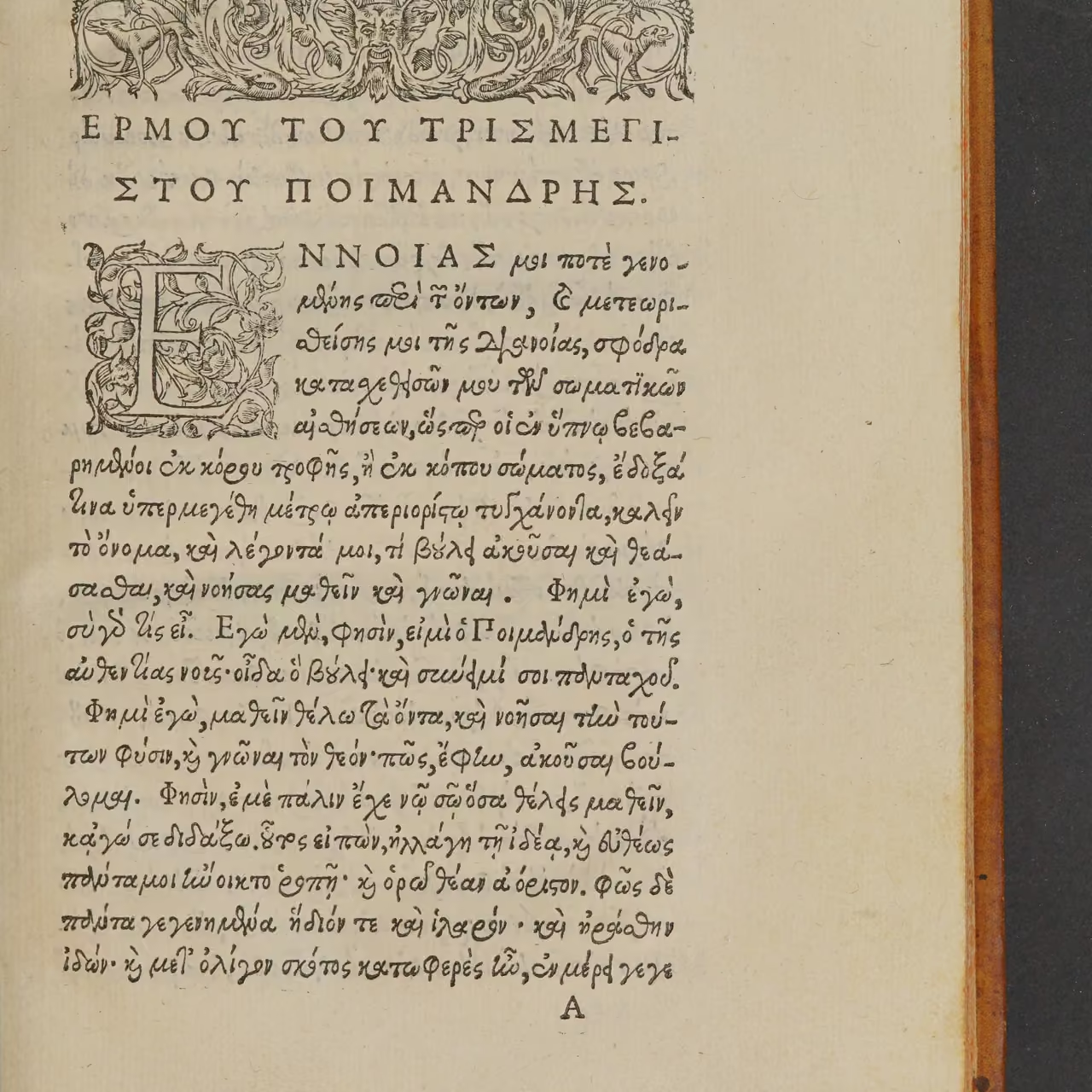
Something new is possible now that has never been possible before. Source Library holds thousands of pre-modern texts in their original languages (Greek, Latin, Sanskrit, Arabic, Chinese) alongside AI translations generated directly from those originals. For hundreds of these works, we also hold historical human translations: the versions that shaped civilizations. Place them side by side, and you can see something no single translation reveals: what each translator chose to hear in the original.
This is the first in a series of experiments with that three-way comparison. We start with the Corpus Hermeticum.
In 1463, a Greek manuscript arrived at the court of Cosimo de’ Medici in Florence. Cosimo ordered his best scholar, Marsilio Ficino, to drop everything (including Plato) and translate it immediately. The text was the Corpus Hermeticum, attributed to the legendary sage Hermes Trismegistus. Ficino believed it was older than Moses.
Ficino’s 1481 Latin translation shaped five centuries of Western esotericism. But Ficino was not a neutral channel. He was a Neoplatonist, a priest, and a man writing for a patron. Every word he chose was an interpretation. Now, for the first time, we can place his rendering next to two others: a 1650 English manuscript translation, and a direct AI translation from the 1554 Greek editio princeps. The AI has no patron, no theology, no agenda. It is a mirror, and what it reflects is what the human translators chose to add.
What follows are three passages from the Poimandres, the first and most famous tractate of the Corpus Hermeticum. In it, Hermes describes a mystical vision: a divine being called Poimandres appears, reveals the creation of the cosmos, and explains the origin and destiny of the human soul.
I. “What Do You Wish to Hear and See?”
Poimandres I.1–2: The Opening Vision
The text opens with Hermes in a state of meditation. His bodily senses are “put to sleep,” and a being of immense size appears. Watch how each translator handles the moment of encounter: what Ficino makes formal and theological, the English scribe makes intimate, and the AI keeps literal.
The Appearance of Poimandres
Once, when I was contemplating the things that exist and my understanding had been lifted high, while my bodily senses were strongly restrained — as if by those who are heavy with sleep from overeating or physical labor — I thought I saw a being of immeasurable size calling my name and saying to me, "What do you wish to hear and see, and having understood, what do you wish to learn and know?"
When I was meditating on the nature of things and raising the sharp point of my mind toward the heavens, the senses of my body were now put to sleep — just as it usually happens to those who are heavy with sleep due to fullness or exhaustion. Suddenly, I seemed to see someone of immense bodily size, who, calling me by name, shouted in this manner: "What is it, O Mercury, that you desire to hear and behold? What is it that you wish to learn and understand?"
"I know what thou wouldest have, and I am always present with thee." Then said I: "I would learn the things that are, and understand the nature of them, and know God." "How?" said he. I answered that I would gladly hear. Then he: "Have me again in thy mind, and whatsoever thou wouldest learn I will teach thee."
II. “From the Light, the Holy Logos Stepped Upon the Nature”
Poimandres I.5–9: The Creation of the Elements
After the initial vision of light and darkness, Poimandres reveals the cosmogony: how fire, air, earth, and water separated, and how the divine Word (Logos) organized chaos into cosmos. This is the passage that most closely parallels Genesis, and where Ficino’s Christian theology leaves its deepest mark.
The Logos and the Elements
From the light, the holy Logos stepped upon the nature, and unmixed fire leaped out from the moist nature up into the height. It was light and sharp and at the same time active. The air, being light, followed the spirit as it ascended from the earth and water up to the fire, so that it seemed to hang from it.
From this voice of light, the Word came forth. Indeed, this Word stood near the moist nature and cherished it. From the depths of that moist nature, a pure and light fire immediately flew out and sought the heights. The air, also being light and following the spirit, took its place in the middle region between the fire and the water.
And the air, which was also light, followed the spirit, and mounted up even to the fire — from the earth and the water — insomuch that it seemed to hang and depend upon it. And the earth and the water stayed by themselves so mingled together that the earth could not be seen for the water; but they were moved because of the spiritual word that was carried upon them.
III. “The Father Brought Forth a Human Equal to Himself”
Poimandres I.12–14: The Creation of the Archetypal Human
The climax of the cosmogony: the divine Mind creates a human being in its own image, who then gazes down through the celestial spheres, sees Nature, and falls in love with his own reflection. This passage is simultaneously a creation myth, a Narcissus story, and the Hermetic answer to the question of why the divine soul is trapped in matter.
The Archetypal Human
The Father of all, the Nous, being life and light, gave birth to a human equal to himself, whom he loved as his own offspring. For he was all-beautiful, having the image of the Father; truly, God also loved his own form. And he delivered to him all his own creations.
He produced a human being similar to himself, and he rejoiced in him as if in his own son. For he was beautiful, and he bore the image of his father. For God, truly delighted with his own form, granted all his works for human use.
But the father of all things, the mind, being life and light, brought forth Man like unto himself, whom he loved as his proper birth. For he was all beauteous, having the image of his father.
Every Translation Is an Interpretation
The point of this exercise is not “AI vs. human: who wins?” No one wins. Every translation is an interpretation, and every interpretation reveals something the others miss. Ficino’s Logos “cherishes” nature because Ficino is a Christian Neoplatonist writing for the Medici. The English scribe’s Word is “carried upon” the waters because the scribe is steeped in the King James Bible. The AI’s Logos “steps upon” nature because the AI has no theology, only the Greek.
What the AI gives us is not a better translation. It is a baseline: a rendering with no cultural agenda, no patron to please, no Romantic sensibility to project. Against this baseline, the human translations become legible as the creative acts they always were. We can see what Ficino added. We can see what the English scribe heard. We can see, in the gaps between all three, the dimensions of the original that no single translation can capture.
Source Library holds 23 editions of the Corpus Hermeticum across five languages and five centuries. Every page is OCR’d, translated, and searchable. This is what a digital library makes possible: not just access to texts, but access to the history of reading them.
Try it yourself
The Corpus Hermeticum is just the beginning. Source Library holds multi-edition, multi-language data for Plotinus, the Bible, Aristotle, the Panchatantra, Shakuntala, and hundreds of other works. Any work with a Compare translations button can be explored this way.
Pick a work you know. Find two editions in different languages. Open them side by side and read the same passage through different centuries, different cultures, different agendas. You will notice things that no single translation could show you, because every translation is a theory about what the original means, and theories are most visible when you can compare them.
If you find a comparison that reveals something surprising, we’d love to hear about it.


