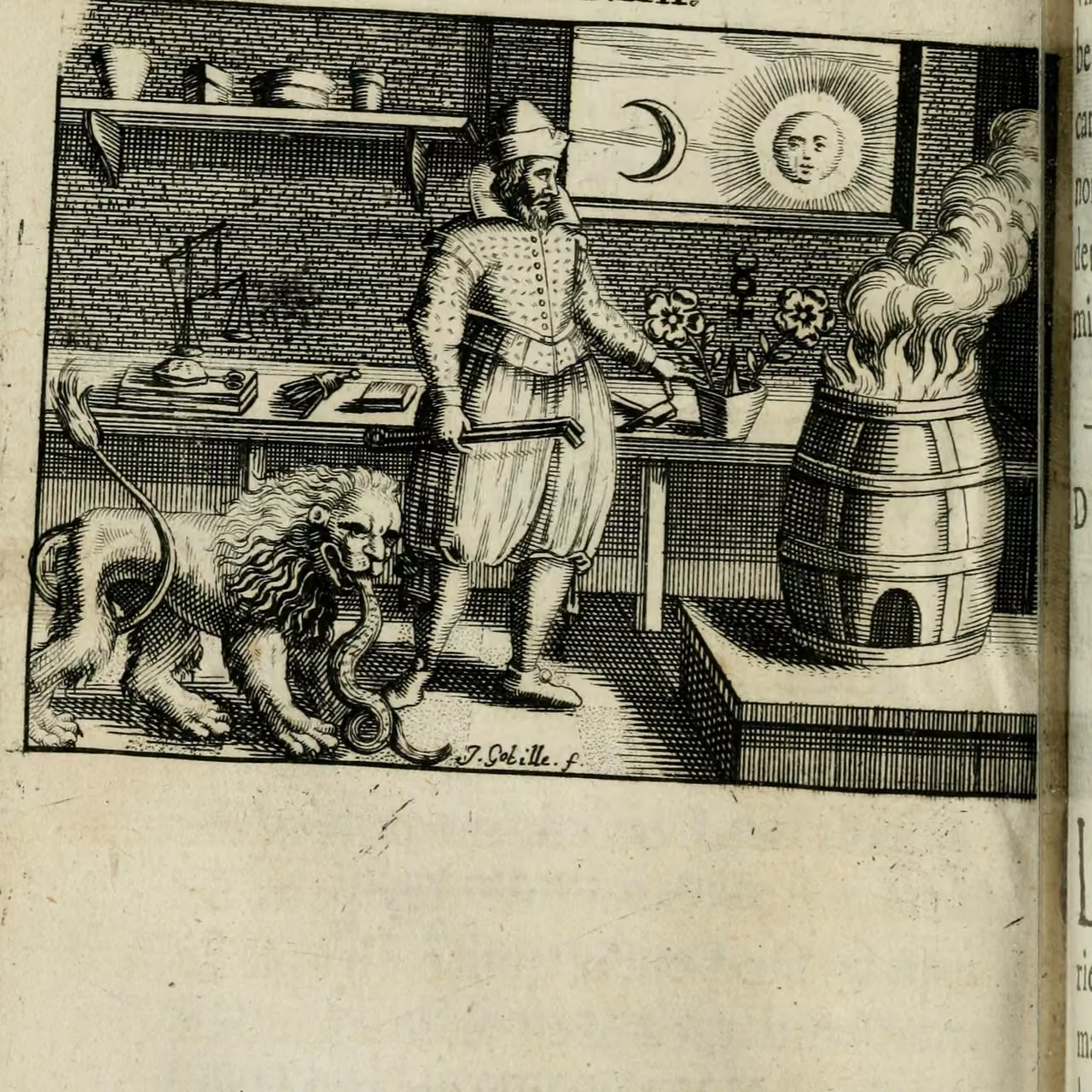
Engraving headed “Clef XII”: an alchemist in his laboratory beside a furnace, a lion devouring a serpent at his feet, the sun and moon in the window.
All articles

10 May 2026

Source Library, by the Numbers

A snapshot of the corpus: what's in it, where it came from, and what it takes to hold it together.

Books
11,965
+22,543 in the warehouse queue
Artworks
14,412
Prints, paintings, illustrated single sheets
Pages translated
3,602,478
83.9% of all book pages
First translations
6,033
First English translation by Source Library

Source Library holds 26,643 works in total: 11,965 books and 14,412 artworks. The numbers below describe the book corpus unless noted.

3.83 billion words on disk

Source Library
3.83B
words, original languages + English translation
Original-language OCR1.69B
English translation2.14B
English Wikipedia, for scale
~4.4B
words across ~6.9M articles
Source Library / Wikipedia87%
Translation alone49%

From scan to readable text

Every book page travels a pipeline: photographed, OCR'd, translated, indexed. Here's how far the 4,294,562 pages of the book corpus have come.

Pages digitized
4,294,562 / 4,294,562
OCR transcribed
3,770,546 (87.8%)
Translated to English
3,602,478 (83.9%)
11,032
Books fully readable (≥90% translated)
81,858
Chapters auto-extracted with AI
7,421
Distinct authors
100,981
Illustrations extracted from page scans

199 languages, from Sumerian to Russian

Books in their original languages, before AI translation. The corpus spans 199 distinct languages and language combinations; the top fourteen are below. Latin and German anchor the European corpus; ETCSL contributes Sumerian; dedicated import streams bring in Chinese, Sanskrit, and Hebrew.

Latin
4,200
German
1,747
English
1,422
Greek
812
French
659
Chinese
582
Dutch
443
Sumerian
377
Sanskrit
343
Russian
242
Italian
223
Hebrew
210
Egyptian hieroglyphs
129
…plus 186+ more, including Akkadian, Avestan, Old Norse, Coptic, Aramaic, Classical Armenian, and dozens of bilingual editions.

Across nearly five thousand years

Distribution of works by century of original composition. The earliest item dates to 2880 BCE (a stela of King Raneb of Egypt's Second Dynasty), and the corpus runs unbroken through to the present. The book corpus peaks in the 1600s (the heyday of Hermetic and alchemical printing), with strong shoulders in the 1500s and 1800s.

143
Pre-1000
133
1000s
96
1100s
120
1200s
176
1300s
914
1400s
2.4k
1500s
3.8k
1600s
2.4k
1700s
3.4k
1800s
1.7k
1900s
2.7k
2000s
Earliest work
Stela of King Raneb
2880 BCE, Egyptian Second Dynasty
Longest book
Greek Old Testament (Tischendorf)
4,369 pages

Where the books come from

Source Library mirrors and unifies digitized holdings from libraries and museums around the world. The provenance of every page is preserved.

Wikimedia Commons
Mostly artworks: open-licensed scans & paintings
11,287
books
Internet Archive
Public-domain books
5,216
books
Embassy of the Free Mind (BPH)
Hermetica, alchemy, Rosicrucian books
2,273
books
Rijksmuseum
Prints & illustrated artworks
1,697
books
Munich Digital Library (MDZ)
German & Latin books
1,338
books
e-rara (Swiss libraries)
Books from Swiss research libraries
537
books
National Gallery of Art
Artworks
452
books
Allard Pierson (Amsterdam)
Books
421
books
ETCSL (Sumerian Literature)
Cuneiform & Sumerian texts
373
books
The Met
Artworks
362
books
…plus dozens of smaller archives. Every book records its source library and original IIIF or IA identifier.

What it takes to hold it

Three primary stores keep the corpus alive: a metadata database, a search-and-text mirror, and an image archive.

MongoDB Atlas
Primary metadata store
65 GB
data, +3 GB indexes
  • 5.7M page records · 41 GB
  • 82K chapter texts · 6.5 GB
  • 811K entities · 1.4 GB
  • 92 collections, 25.5M documents total
Supabase Postgres
Search & embeddings
3.4M
page records (text mirror)
  • Full-text search across every translated page
  • 30,564 book-level vector embeddings
  • Per-page CLIP image embeddings for visual search
  • 7-lane semantic search powers /search
Cloudflare R2
Image archive
~2 TB
across ~12M image objects
  • 3.9M archived full-res JPEGs (~286 KB each)
  • 3.9M 1200px display images + thumbnails
  • 100K extracted illustrations & artworks
  • BPH JP2 originals from Embassy of the Free Mind

Generated by AI

Every translation, summary, and chapter index in Source Library is produced by Google Gemini models. The original text is always preserved, one click away on every page.

OCR transcriptions
3,770,546
From scan to original-language text
Page translations
3,602,478
Original languages → English
Book embeddings
30,564
For semantic similarity & search
Illustrations catalogued
100,981
Subjects, figures, symbols, technique

A knowledge graph of 811,127 entities

Every translated page is scanned for the people it names, the places it mentions, and the concepts it invokes. The result is a connected graph that links Hermes Trismegistus to Marsilio Ficino to a print on the Rijksmuseum's wall.

Concepts
438,516
Ideas, doctrines, symbols, schools of thought: the abstract anchors of the Hermetic and Renaissance corpus.
People
264,049
Authors, philosophers, alchemists, kings, mystics: every named person across the translated corpus.
Places
111,677
Cities, monasteries, libraries, regions: geocoded where possible and linked to the books that mention them.

Tokens, end to end

Reading the corpus and translating it has cost about 27 billion Gemini tokens across every phase of the pipeline.

Pipeline tokens
27.1B
Total Gemini input + output, all phases
Corpus words
3.83B
OCR + translation, tags stripped
Total AI cost
$17,674
Cumulative spend, all Gemini calls
API calls
5.7M
Across OCR, translation, indexing, vision

Tokens by pipeline phase

OCR (vision → original-language text)
11.04B
$5,612
Translation (original → English)
7.21B
$7,366
Indexing & summary
4.21B
$2,229
Image extraction (vision)
3.39B
$2,009
Transliteration
0.57B
$157
FT verification & misc
0.73B
$301
Snapshot taken 2026-05-07. Counts grow daily as the pipeline runs. See live status at /status.

How this article was made

This is an AI-assisted article. Derek Lomas set the question; AI models searched the library, read the sources and drafted the text, which was reviewed before it was published.

Every quotation is checked by machine against the scanned page it comes from and links to that page, so you can read the original yourself. The article is a living document: it is revised when a reader finds an error or the library gains a better source.

How these articles are made · Last revised 18 October 2026 · Revision history · Spot an error? Suggest an edit

More from the same category first, then the newest articles.